A garage door is the largest opening in most homes in this part of Florida, and in a wind event it is also the most exposed one. When wind gets into a garage, the pressure has to go somewhere, and it typically goes up into the roof structure. That is why the building code here treats the garage door as a structural component rather than a convenience, and why the door has to carry a rating for the wind pressures at a specific address. This article explains what a windload rating actually is, what the label on the door means, what a homeowner can safely note from outside the door, and when the work belongs to a technician or a licensed contractor. It does not quote prices, because this business has not published any.
What "hurricane-rated" actually means
The phrase gets used loosely in conversation, but the underlying idea is specific. A garage door is rated for a design wind pressure, expressed in pounds per square foot, and for the direction of that pressure: positive pressure pushing the door inward, and negative pressure pulling it outward as wind flows over the building. A door that passes one test and not the other is not fully rated for a wind event.
Western Broward County sits in a high-velocity hurricane zone, and the code requirements that apply here are stricter than in much of the country. The rating a door needs depends on the building's exposure, the height of the structure, and the door's size and location, which is why the number is not the same for every house on a street. A licensed contractor or engineer works that out for a specific address. What matters for a homeowner is that the door, and the hardware that holds it, were selected for that address and that the rating is documented.
The label, and why it matters after installation
A rated door carries a permanent label, usually on the inside face of a panel or on the end stile, showing the manufacturer, the model, the design pressure, and the approval body behind the rating. That label is the evidence. It is what an inspector looks for, and it is what a future buyer's inspector will look for.
Two things commonly go wrong with the label. The first is that it gets painted over during a repaint, which obscures the information without changing the door. The second is that the label survives but the door no longer matches it, because a panel was swapped for a different model after a dent, or the door was replaced entirely with an unrated unit. If the label on your door is painted over, missing, or does not match the door you see, a technician can identify the assembly and tell you whether the rating can be confirmed. Reading and interpreting the label is part of that visit, not something to work out yourself.
Why the hardware is part of the rating
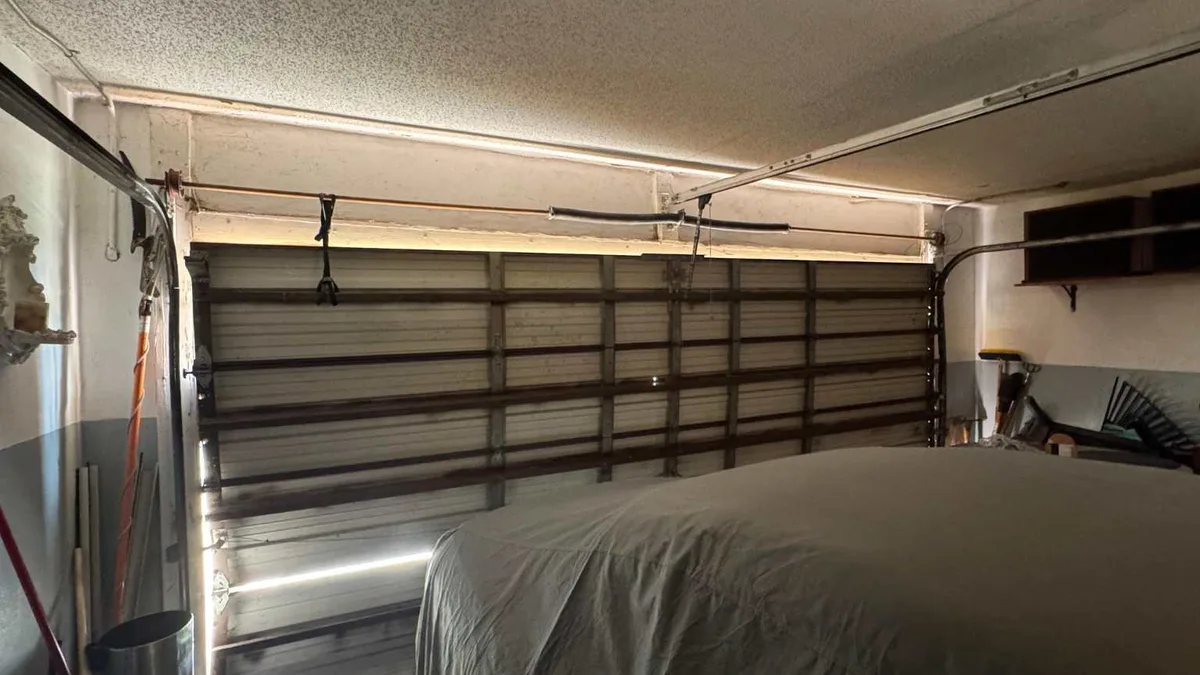
A windload rating is not a property of the door panel alone. It covers the whole assembly: the panels, the hinges and struts that tie them together, the tracks, the rollers, and the anchors that fasten the tracks to the framing. A door rated for a given pressure with its original reinforcement is not rated for that pressure once a strut has been removed or a track has been re-anchored with lighter fasteners.
This is the reason a garage door repair here is not always a like-for-like swap. When a panel is damaged, the replacement has to match the rated assembly, and when a track is bent, the repair has to restore the anchoring the rating assumes. A technician who works in this area checks the label before choosing parts. If you are scheduling panel or track work, mention that the door is rated and ask that the replacement parts match the label. That conversation is worth having before the work starts rather than after.
What you can safely note from outside the door
You do not need to touch the springs, cables, or opener drive train to get useful information about a rated door. With the garage empty and the door closed, a few things are visible, and they tell you whether the assembly is in the condition the rating assumes.
- The door sitting crooked. A door that hangs at an angle when closed, or shows a widening gap along one side, is not sitting square in its opening. That can come from a snapped cable, a broken spring, or a bent track, and the test that separates them is one a technician performs.
- A gap along the top or sides. Wind-driven rain enters through gaps that a properly adjusted door does not leave. Weather seal and insulation work addresses this, and it is separate from the structural rating.
- New noise at the start of a cycle. A clunk or a grind that was not there before can come from a roller, a hinge, or a dry bearing. Which one it is takes someone at the door while it runs.
- The door feeling heavier in normal use. If the door seems to take more effort to raise than it used to, the spring system may no longer be carrying its share of the weight. Do not test this by hand or by lifting the door. Have a technician evaluate it.
None of these observations tells you whether the door will hold its rated pressure. They tell you whether the assembly is in the condition the rating assumes. A door that is out of adjustment is not performing as rated, whatever the label says.
Before storm season, and after a repair
The practical sequence for a homeowner is straightforward. Confirm that the label is present and that the door matches it, and keep a photo of it with your home records. Keep the door adjusted so it closes squarely and seals against the opening. Have a technician check the springs, cables, rollers, and track anchoring as part of routine service, since those are the parts that carry the load and the parts a homeowner should not be working on. After any panel, track, or hardware repair, confirm the replacement parts match the rated assembly and that the label is still in place.
If you are unsure what your door is rated for, or a repair has left you uncertain whether the assembly still matches its label, that is a question for a licensed and insured technician who can read the door and the documentation together. The Broken Spring Garage Door Repair LLC serves Sunrise, Fort Lauderdale, Tamarac, Plantation, Coral Springs, and Weston. You can reach the office at 954-414-9504 or info@thebrokenspring.com, or visit at 4850 Northwest 103rd Avenue, Sunrise, FL 33351. Hours are Monday through Friday 7:00 AM to 7:00 PM and Saturday and Sunday 8:00 AM to 6:00 PM, with emergency service available.