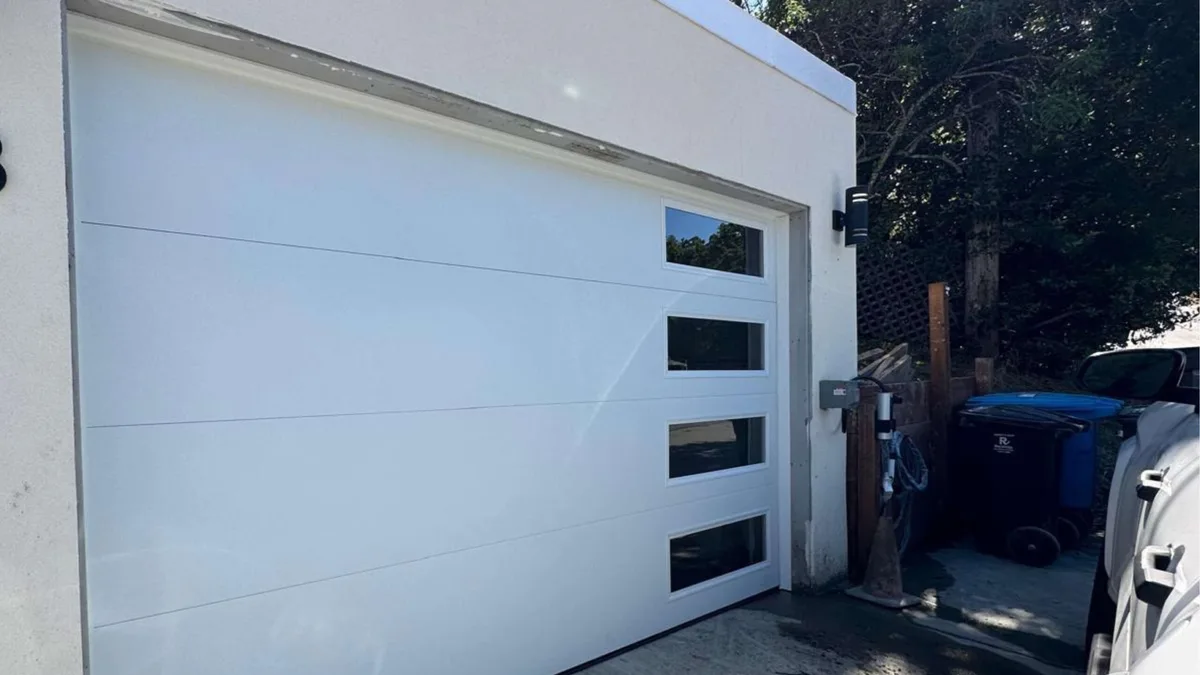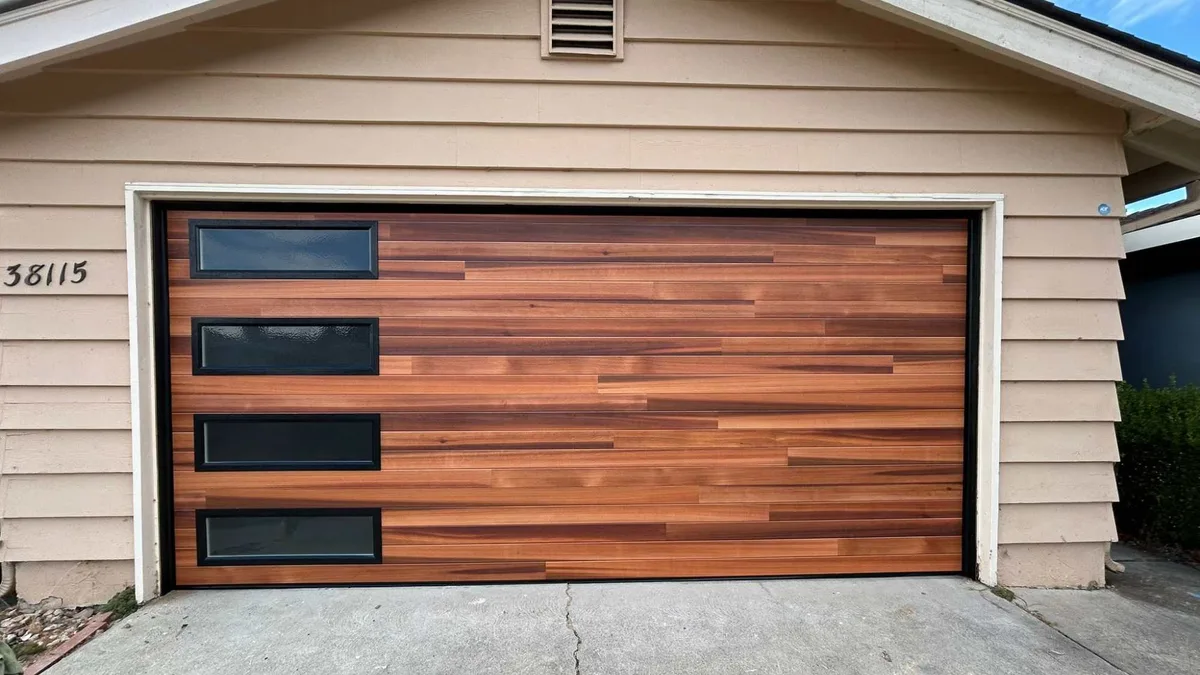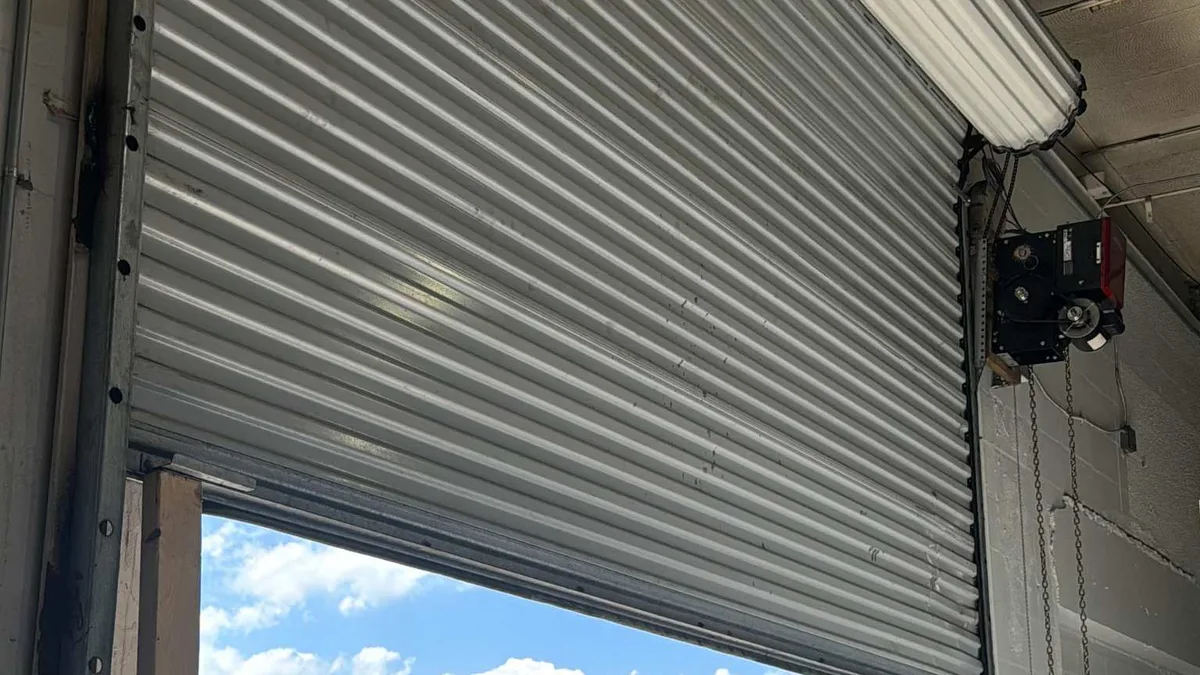
Not every garage gives the opener the room it wants. In plenty of homes the ceiling sits close above the door, sometimes with a beam, a duct, or a storage shelf crowding the same space. When the opener quits and you start shopping for a replacement, that tight ceiling becomes the first thing that decides what will work. The good news is that the question is answerable with a tape measure and a little patience. The catch is that some of the measuring involves hardware you should not be poking at yourself.
Start with the numbers you can safely take
You do not need to climb anything or reach over the door to gather the useful figures. With the door closed and the opener off, measure and write down:
- Floor to ceiling, taken directly under the center of the door opening and again a few feet back where the motor would hang.
- Floor to the bottom of any obstruction overhead — a beam, a duct, a light fixture, a shelf. The lowest thing in the path is the number that matters, not the bare ceiling.
- Width of the opening and the rough depth of the garage, so you know how far back the rail can run.
- The door's make and model, usually on a label on one of the panels or the bottom section.
Those four items, plus a photo of the whole overhead area taken from the floor, give a technician almost everything needed to advise you. What you should not do is climb a ladder to measure around the spring shaft, the cables, or the brackets that hold them. That hardware is under load, and a tape measure snagged on a cable is a genuine hazard. Leave that part of the survey to a technician.
Why the ceiling height alone does not answer the question
Two garages with the same floor-to-ceiling measurement can take completely different openers, because the deciding factor is not the ceiling — it is the highest point the door reaches when it is fully open, and what sits between that point and the ceiling. A door that tracks close to the ceiling leaves very little room for a rail and motor head. A door with a different track configuration may leave more. A beam running across the middle of the ceiling can rule out a center-mounted unit no matter how much room the edges have.
This is why a simple "you need X inches" rule from a neighbor or a forum is unreliable. The requirement is specific to the door, the track, and the model of opener, and it is printed in the installation manual for that opener. The manual is the authority; anything else is a guess.
The main approaches when headroom is tight
Broadly, there are two families of solution, and which one applies depends on your door and the hardware above it.
Openers that mount overhead but sit closer to the ceiling
Some residential openers are built with a more compact motor head and a rail designed to keep the assembly tight to the ceiling. These can be the simplest answer when there is a modest amount of room to work with. Whether a given model fits your garage is a question for its manual and for the technician measuring your door's travel.
Openers that mount to the side rather than the ceiling
Wall-mounted and jackshaft-style openers drive the door from beside it instead of from a rail overhead, which frees the ceiling entirely. They depend on the door having the right kind of counterbalance hardware, and they are installed on and around that hardware. That installation is technician work, not a homeowner project, and it is not something to attempt based on a web article.
In both cases the door itself still has to open and close along its tracks without striking anything. Changing the opener does not change the door's path. If the door cannot fully open because of the ceiling or an obstruction, the fix may involve the track configuration, and that is a separate assessment.
What you can check yourself, and what to hand off
From the floor, with the opener disconnected and the door closed, you can confirm:
- Whether anything is stored on shelves or hung from the ceiling in the door's path.
- Whether the door opens and closes by hand smoothly, without binding or scraping.
- Whether the door hangs level. A door that sits at an angle is a sign of a cable or spring problem, and it should be looked at before any opener decision.
- Whether the existing opener's motor runs without moving the door — a stripped gear will do that, and it is a repair question, not a clearance question.
Anything involving the springs, cables, brackets, or the shaft they ride on goes to a technician. That includes measuring clearances around them and deciding whether a side-mount opener is even possible on your door.
Getting a straight answer for your garage
Gather your measurements, your photos, and the door's model number, then have a technician confirm the clearance and recommend an opener that suits the door and the ceiling. The Broken Spring Garage Door Repair LLC serves Sunrise, Fort Lauderdale, Tamarac, Plantation, Coral Springs, and Weston, and is licensed and insured. You can reach them at 954-414-9504 or info@thebrokenspring.com, or visit 4850 Northwest 103rd Avenue, Sunrise, FL 33351. Weekday hours are 7:00 AM to 7:00 PM, weekends 8:00 AM to 6:00 PM, with emergency service available. An opener that fits properly is worth the measurement; one that does not can damage the door or put someone at risk.