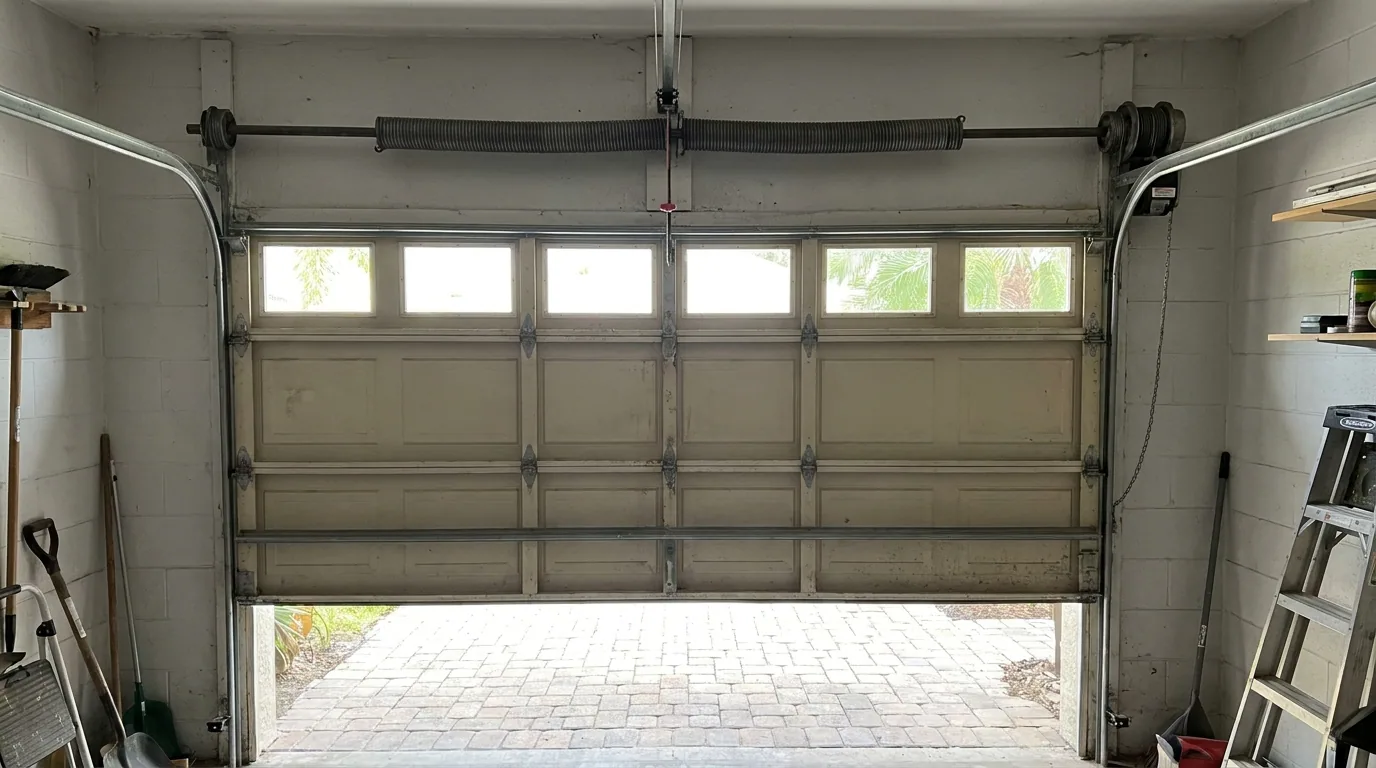
A broken torsion spring announces itself in a few ways. The door comes up partway and stops. The opener motor runs but the door does not rise. Or the door is simply stuck, and when you press the button you hear the motor straining against something that will not move. If you suspect a spring has failed, the most useful thing to understand is why the door behaves this way, and which of the obvious next steps are safe for you and which are not. A torsion spring that has snapped cannot hold the door's weight, and the opener is not built to take over that job. The door is heavier than the hardware was designed to move without the spring's help, and forcing it is how people get hurt and how openers and doors get damaged. This article covers what you can safely do to get the door open, what you should never attempt, and when to call a technician.
First, confirm what you are dealing with
Before you do anything, keep the garage empty of people and pets and watch one cycle from a safe distance. With the door closed, press the wall button and note exactly what happens. The motor may run and the door may not move at all, or the door may rise a foot or two and hang there. Either pattern is consistent with a spring that can no longer carry the door's weight, though a stripped opener gear can also let the motor run without lifting the door. A technician separates those two by checking the opener's drive train and the spring assembly directly.
You may also notice the door sitting crooked in the opening, a gap along the top, or the door feeling heavier than usual when you use it normally. Those are things to report, not things to fix. Do not pull the emergency release to test the door by hand, and do not try to lift the door yourself to see how heavy it is. A door with a failed spring can drop suddenly once it is moved off balance.
What you can safely do to get the door open
If the door is closed and you need to get a car out, the safest option is usually to leave the door where it is and call a technician. If you must open it, do it with the opener only, in short presses, and stop the moment the door behaves abnormally. Do not stand under the door while it moves, and keep children and pets clear of the opening.
If the opener will not move the door at all, do not keep pressing the button. Repeated attempts strain the motor and the drive train against a load they were not designed to move. If the door is already partway up and hanging, leave it there and call for service rather than trying to bring it down or push it up.
If the door is open and will not close, the same rule applies: do not force it. A door that reverses before it reaches the floor is a travel-limit or force-setting problem, not a photo-eye problem. A blocked or misaligned photo-eye reverses a door only while it is closing, so it is worth checking that the path is clear, but do not treat the photo-eye as the explanation for every reversal.
What not to touch, ever
The torsion spring, the cables, and the opener's drive train are under load and are technician work. Do not try to wind, unwind, or adjust a spring. Do not cut, loosen, or re-route a cable. Do not open the opener housing to look at the gear. Do not pull the emergency release and move the door by hand. These are the steps most likely to cause a serious injury, and none of them are necessary to get your door working again.
If you are unsure whether a part is safe to touch, assume it is not. The technician inspects the springs and cables as part of the service call, and that inspection is one of the reasons to have the door looked at rather than worked around.
When to call, and what to tell the technician
Call for service as soon as you confirm the door will not move normally. The Broken Spring Garage Door Repair LLC serves Sunrise, Fort Lauderdale, Tamarac, Plantation, Coral Springs, and Weston, and can be reached at 954-414-9504 or info@thebrokenspring.com. The business is licensed and insured, and emergency service is available outside the regular hours of Mon-Fri 7:00 AM - 7:00 PM and Sat-Sun 8:00 AM - 6:00 PM.
When you call, describe what you saw: whether the motor runs, whether the door moves at all, whether it hangs crooked, and whether you heard a bang from the garage. Those details help the technician arrive prepared for a spring replacement rather than a diagnostic visit. Do not attempt a repair yourself in the meantime. A door held open by a failed spring is a door waiting to come down, and the safest place for it until the technician arrives is closed and untouched.