
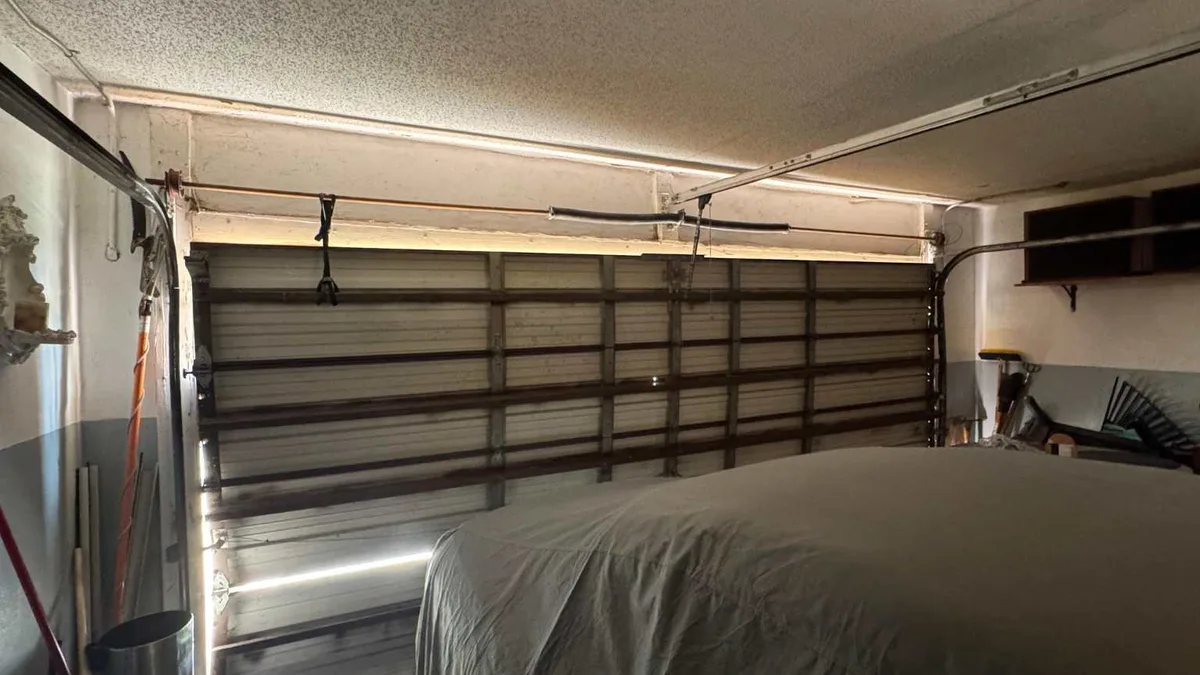
You press the remote, the opener hums, and the door does not move. Or it jerks up a few inches and stops. In a suburban single-family home, that moment usually traces back to one part: the spring. It is the component that carries the weight of the door so the opener only has to guide it along the tracks. When a spring fails, the door becomes a very heavy object that the motor was never built to lift on its own. What follows is how to confirm what happened by looking, not touching, and what to do with the rest of your day.
How to tell the spring is the problem
Stand a few feet back in the driveway and look at the hardware above the door. You are looking, not reaching. On a torsion system there is a horizontal steel shaft across the top of the opening with one or two coiled springs mounted on it. On an extension system the springs run along the horizontal tracks on each side and stretch as the door moves.
Signs that point to a broken spring:
- A visible gap in the coil. A torsion spring that has failed is usually split into two pieces, and the break is often obvious from the ground as a clean separation in the winding.
- A loud bang from the garage. Many homeowners hear something like a gunshot or a car backfire. That is the sound of a torsion spring releasing its stored energy all at once.
- The opener runs but the door barely moves. The motor strains, the door rises an inch or two, then stops or reverses. Some openers shut themselves down to protect the motor.
- The door hangs crooked. With two springs, one failing leaves the other doing all the work, so the door lifts unevenly or binds on one side.
- The door feels immovable. If you try to raise the door by hand and it will not budge, stop. Do not keep pulling on it.
If you see any of this, stop using the opener. Repeated attempts put load on a motor that is not built for it and can burn it out, turning one repair into two.
Why springs break in the first place
A garage door spring is a piece of steel that is deliberately twisted under tension and held there. Every open and close cycle flexes it. Over thousands of cycles, metal fatigue accumulates at the point of highest stress, usually near one end, and eventually the steel gives. That is how these parts are designed to wear out, and it is the reason a door that worked fine yesterday can be dead this morning.
Several conditions speed it up:
- Heat and humidity. A warm, damp garage keeps moisture against the coils. Rust pits the surface of the steel and gives a crack a place to start.
- Cycles, not years. A door used four times a day wears far slower than one used a dozen times a day. What matters is how many times the spring has been wound and released, not how old the house is.
- An unbalanced or binding door. If the door has been dragging or the springs have been carrying more than their share, they work harder on every cycle.
- Missed lubrication. Dry rollers, hinges, and bearings make the opener and the springs work against extra friction.
That is also why a spring can break on a quiet Tuesday with the car parked inside. Nothing dramatic happened. The part simply reached the end of its cycle life.
What to do in the first ten minutes
- Stop cycling the door. Take the remote out of the car and stop pressing the wall button to see if it will work this time. Leave the opener itself alone and let a technician handle it.
- Keep the area clear. Do not park under the door and do not let children use the garage as a play area until it is repaired. A door held up by a failing spring can come down hard.
- Look, do not touch. Torsion springs, cables, and the shaft are under extreme tension even when the door is closed and the opener is off. Never attempt to wind, unwind, cut, or adjust a spring, and never remove a cable. This is the one part of garage door work that genuinely belongs to a trained technician with the right winding bars and the knowledge to use them.
- Check the simple non-spring causes. If the spring looks intact, look at the photo-eye sensors near the floor on each side of the opening. A misaligned or dirty lens, or an object sitting in the beam, will stop a door from closing. Check that the wall switch has not been locked out.
- Call for service. Describe what you saw and heard: the bang, the gap in the coil, whether the door is crooked, and whether the opener still runs. That helps the technician arrive with the right springs for your door.
If the door is stuck open and you need the house secured, do not force it down. Trying to lower a door with a failed spring by hand is how people get hurt. Let the technician handle it.
Replacing one spring or both
When a door has two springs and one breaks, the other has absorbed the same number of cycles and is close to the end of its life. Replacing only the failed one often means a second service call soon after. A technician can measure the wire size, inside diameter, and length of the existing springs and match them, so the door ends up balanced and the opener is not fighting the door.
After the repair, the door should lift smoothly by hand and stay put when you let go at the halfway point. If it drifts down or shoots up, the balance is off and it should be adjusted before you use the opener again. Ask the technician to show you that check while they are there.
Simple habits that extend spring life
You cannot stop metal fatigue, but you can slow it down. Once a year, have the moving parts lubricated with a proper garage door lubricant: rollers, hinges, bearings, and the torsion shaft. Keep the tracks clean and free of debris, and resist the urge to grease the tracks themselves, since lubricant there collects grit. Watch for a door that has become noticeably heavier or noisier, and have the balance checked rather than waiting for a bang. Rust is the other thing to watch. If you see orange dust or pitting on the coils, mention it when you call, because that spring is telling you it is closer to the end than its age suggests.
If your door is stuck, making noise, or hanging crooked, The Broken Spring Garage Door Repair LLC serves Sunrise, Fort Lauderdale, Tamarac, Plantation, Coral Springs, and Weston. Reach us at 954-414-9504 or info@thebrokenspring.com. Weekday hours are 7:00 AM to 7:00 PM, weekends 8:00 AM to 6:00 PM, and emergency service is available. We are licensed and insured.