
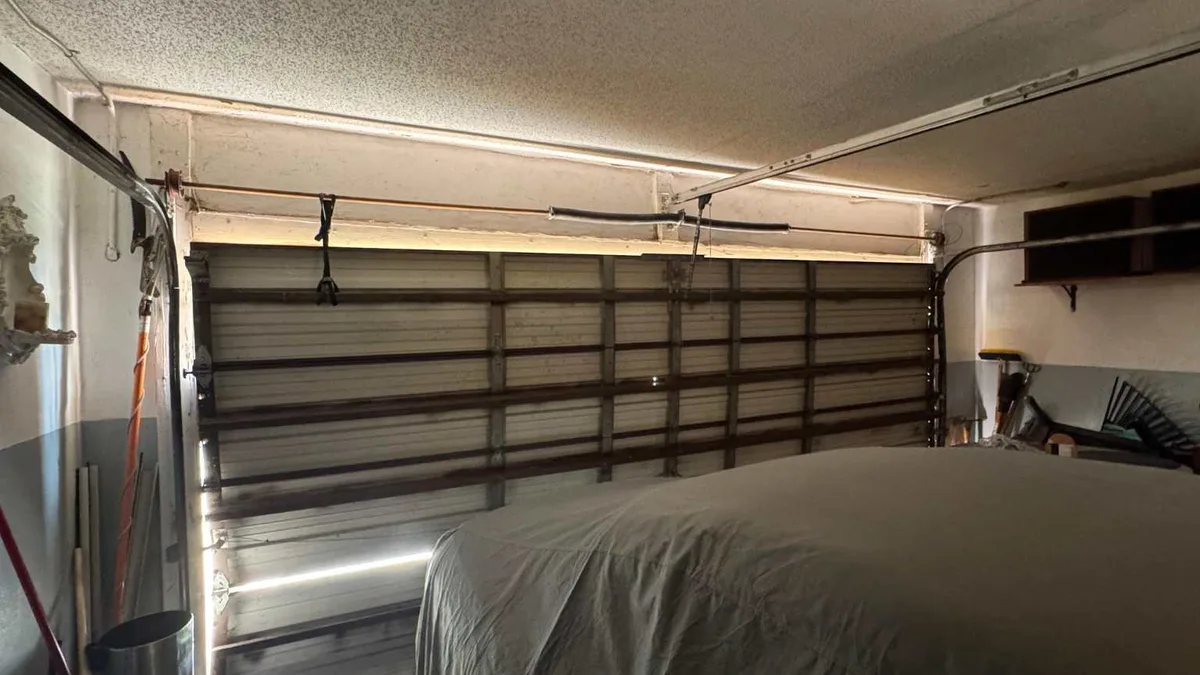
A garage door spring rarely fails without warning. It gives notice, usually over weeks, in ways you can see and hear from the driveway without touching anything. The trouble is that the early signs are easy to write off as the door "getting old," and by the time the spring actually breaks, the door is dead weight and the opener is taking a beating it was never designed for. This article covers what a failing spring looks like from the outside, which symptoms point clearly at the springs, which ones could just as easily be something else, and where the homeowner's part of the job ends. Springs, cables, and the opener drive train are technician work — the useful thing you can do is recognize the symptom and describe it accurately when you call.
The door feels heavier than it used to
This is the most reliable early sign, and you do not need to test anything to notice it. If you use the opener and pay attention to how the door moves, a spring that is losing tension shows up as weight. The door comes down faster than it used to. It lands harder. The opener sounds like it is working for its living on the way up, where before it glided.
The mechanism here is straightforward and worth understanding. Torsion or extension springs are sized to carry the door's weight through its travel. When they are wound correctly, the door is close to neutral — the opener is pushing against friction, not against gravity. As a spring weakens, the door's weight shifts back onto the opener and onto you. That extra load is what wears out gears, stretches chains, and eventually leaves a door that will not stay up.
What this does not tell you is which spring is at fault, or whether the problem is a spring at all. A door that binds in its tracks also feels heavy, and so does one with a failing roller or a track that has been knocked out of alignment. The weight is real either way; the cause needs a technician to sort out. What you can do is note when it feels heavy — all the way through the travel, or only in the first foot or the last foot — because that pattern is useful information when you call. Do not lift the door by hand to test it, and do not pull the emergency release to see how it moves. A door being held up by a weakened spring can come down hard, and the balance check itself is technician work.
A gap along the top, or a door that sits crooked
With the garage empty and the door closed, stand back and look at the door as a whole. Two things are worth noting.
First, a gap along the top of the door. If the door no longer meets the header evenly — one corner low, daylight showing where it used to seal — the door is not sitting square in the opening. Second, a door that hangs at an angle when it is partway up, or one side that trails the other as it moves.
A door hanging at an angle has a short list of likely causes: a snapped cable, a broken spring, or a bent track. Those three produce a similar-looking symptom and they are not distinguished by looking harder from the driveway. The technician separates them by inspecting the springs and cables directly and checking the track for deflection. What you can report is the angle itself — which side is low, whether it happens at the start of travel or the end, and whether it changed suddenly or crept in over time. A sudden change points one way; a gradual one points another.
One caution about the gap along the top: it is not always a spring. A door that closes but leaves a gap can have a travel-limit problem, a worn bottom seal, or a track issue. The gap tells you the door is not seating correctly. It does not tell you why.
The sound at the start of a cycle
Listen to the first two seconds of the door's travel. That is where a failing spring tends to announce itself — a sharp bang or pop at the moment the opener takes up the load, or a heavy thud as the door starts to move. A spring that has broken outright usually makes a loud report, like a gunshot, and the door stops moving or becomes very difficult to move. That one is unambiguous.
The softer sounds are the ones that get ignored. A new squeal, a grind, or a rattle at the start of a cycle can come from a roller, a hinge, a dry bearing, or a spring that is no longer doing its share. Those possibilities overlap, and the sound alone will not separate them. What helps is location: is the noise at the top of the door, along the track, or at the opener itself? Is it there on the way up, the way down, or both? A technician can trace it in person; from the driveway, your job is to describe it precisely.
Be careful about attributing a sound to the weather. It is common to notice the door is louder on some mornings than others, and it is tempting to explain that with temperature or humidity. The honest answer is that a door can sound different from one day to the next for several reasons, and the mechanism is not something to guess at. Note that it is louder, note when, and let the technician find the source.
What is certain, and what is a guess
It helps to be clear about which conclusions are solid.
- Certain: a broken torsion spring cannot hold the door's weight. If a spring has snapped, the door will be heavy and the opener will not lift it reliably. That is mechanical fact, not a diagnosis.
- Certain: a door with a snapped cable hangs at an angle. If you see the door hanging crooked, a cable is one of the possibilities that must be ruled out.
- Not certain: a door that feels heavy, a gap along the top, or a new noise. Each of those has several possible causes, and picking one from the driveway is guessing.
The practical takeaway is that you do not need to diagnose the spring yourself. You need to notice the symptom, note when it happens, and stop before you touch anything under tension. Springs, cables, and the opener drive train are the parts that injure homeowners, and they are the parts a technician is equipped to inspect and replace.
When to stop using the door and call
If the door will not stay up, comes down hard, hangs at an angle, or makes a loud bang and then stops responding, stop operating it. Running an opener against a door whose spring has failed puts the full weight of the door on the opener's gears and rail, and it can turn a spring replacement into a larger repair. Leave the door where it is and call.
For homeowners in Sunrise, Fort Lauderdale, Tamarac, Plantation, Coral Springs, and Weston, The Broken Spring Garage Door Repair LLC handles spring repair and replacement along with the related work that often comes up at the same time — panel repair, opener service, and weather seal replacement. The company is licensed and insured, and the phone line is 954-414-9504. Weekday hours are 7:00 AM to 7:00 PM and weekend hours are 8:00 AM to 6:00 PM, with emergency service available. You can also reach the office at info@thebrokenspring.com or at 4850 Northwest 103rd Avenue, Sunrise, FL 33351.
When you call, the most useful thing you can give the technician is a plain description: what the door does, when it started, and what you heard. That short report is worth more than any guess about which part failed — and it is the part of the job that is safely yours.