
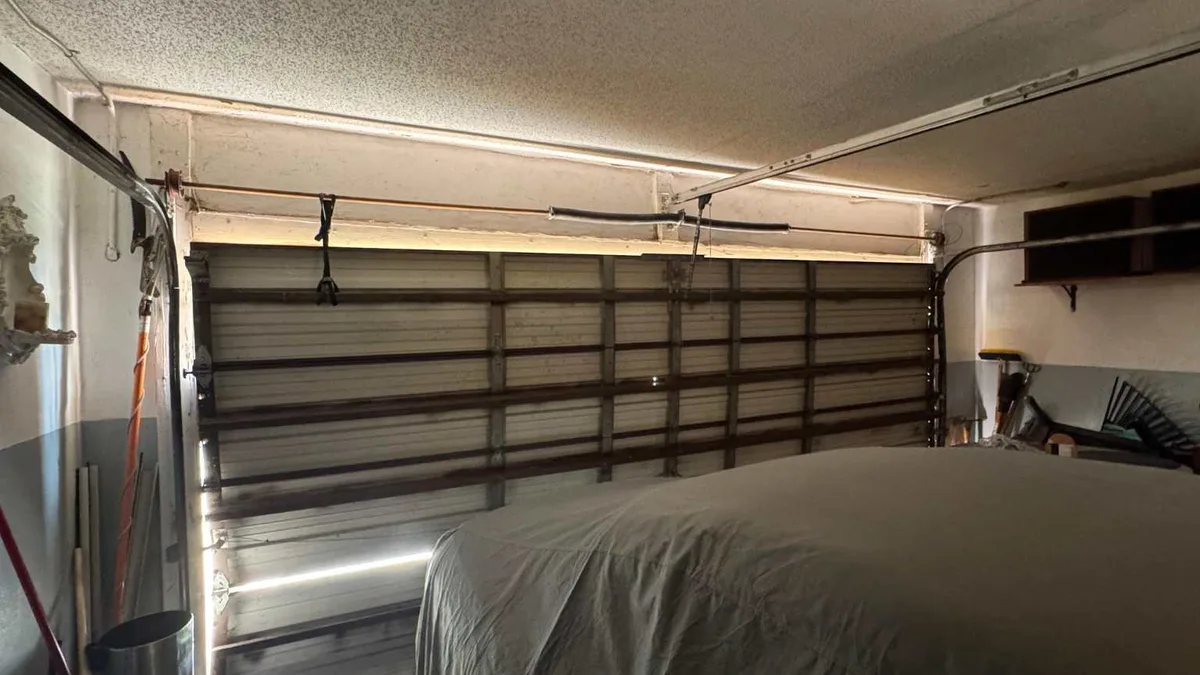
A torsion spring breaks and the door stops coming up, or rises partway and hangs there. When a technician arrives, the recommendation is often to replace both springs rather than only the broken one. To a homeowner that can sound like an upsell. Usually it is not. The two springs on a standard torsion assembly were made together, installed together, and have carried the same door through the same number of cycles. When one fails, the other is at the same point in its life. This article explains why the pair wears together, what a failing spring looks like from outside the door, and what a replacement involves. It does not quote prices, because this business has not published any.
What the springs actually do
On a torsion system, the springs are mounted on a shaft above the door and are wound to store energy. That stored energy does most of the work of lifting the door. The opener's job is to nudge the door along and control the descent, not to haul the full weight of the door on its own.
That division of labor is why a broken spring is such a hard stop. A torsion spring that has snapped cannot hold the door's weight, and the opener is not built to take over. The door may not move at all, or it may move a little and stop. Either way, it is not a problem to work around. Leave the door down and call for service rather than cycling it repeatedly, which puts strain on the opener and the door hardware.
Why the pair wears together
Two springs on one shaft share the load. Each one carries roughly half the door's weight, so each one goes through the same flexing every time the door opens and closes. Over a few years of daily use, both springs accumulate the same number of cycles.
Springs do not wear unevenly in the sense of one staying fresh while the other tires. They are cycled in lockstep, so when one reaches the end of its fatigue life, the other is essentially there too. Replacing only the broken spring leaves a door supported by one new spring and one near the end of its life. The older spring is the likely next failure, and when it goes, the door is down again and the job is repeated.
Replacing the pair at once is standard practice for that reason. It also keeps the two sides balanced, which matters for how the door tracks and how long the opener lasts.
What you can notice from outside the door
You do not need to get near the springs to know something is wrong. Springs and cables are technician work. What you can observe from the floor, with the garage empty and the door operated as you normally would:
- The door sits crooked. One side higher than the other when the door is down or partway up. A snapped cable can cause this, and so can a broken spring or a bent track. A technician sorts out which by inspecting the hardware.
- A gap along the top. The door does not meet the header evenly, or one corner sits lower than the other.
- The door feels heavier in normal use. If the door takes noticeably more effort to raise than it used to, the springs may no longer be carrying their share. Do not test this by lifting the door by hand; note how it behaves during an ordinary cycle and report that to the technician.
- A new noise at the start of a cycle. A bang, a pop, or a sharp report right as the door begins to move is worth reporting. A squeal is less specific, since it can come from a roller, a hinge, or a dry bearing.
If the door will not open at all, or opens a foot and stops, stop operating it and call for service.
What replacement involves
A torsion spring replacement is technician work, and not a small job. The springs are under tension, and the winding process is where the stored energy is set. A technician will typically:
- Confirm what failed. The technician inspects the springs and cables, checks the door's balance, and verifies the track and rollers before quoting the job.
- Measure the door. Spring size is matched to the door's weight and height, not chosen by eye.
- Wind down the old assembly, remove both springs, and install the new pair.
- Set the tension, then check that the door travels evenly and that the opener's limits and force settings are correct for the new springs.
Because the opener was set up around the old springs, the settings usually need attention after replacement. A door that runs smoothly but slams at the floor, or reverses before it reaches it, is usually a travel-limit or force-setting issue rather than a spring problem. That is a quick adjustment, but it needs to be made.
Getting help in western Broward County
If your door has stopped and you suspect a spring, do not try to diagnose it at the shaft. Call a technician. The Broken Spring Garage Door Repair LLC serves Sunrise, Fort Lauderdale, Tamarac, Plantation, Coral Springs, and Weston, and is licensed and insured. Reach the office at 954-414-9504 or info@thebrokenspring.com. Hours are Monday through Friday 7:00 AM to 7:00 PM and Saturday and Sunday 8:00 AM to 6:00 PM, with emergency service available.