When the power goes out in a Sunrise neighborhood, the first thing many homeowners notice is that the garage door will not move. The wall button clicks, the light on the opener may even come on, but the door sits there. That is not a failure of the opener itself. It is a failure of the assumption that the opener will always have household current to draw on. A battery backup is the part of the system that covers the gap between the two. It is a small, self-contained unit mounted on or beside the opener head that holds a rechargeable battery and a charging circuit, and it takes over the low-voltage work of running the motor when the outlet behind the opener goes dead. This article explains what the backup does, what it does not do, how to tell whether yours is still ready, and when the work belongs to a technician.
What a battery backup actually does
A garage door opener runs on household current, stepped down to low voltage inside the unit. Under normal conditions the charger in the backup keeps the battery topped up while the opener runs from the wall outlet. When the outlet loses power, the backup switches the opener over to the battery, and the motor continues to run from that source instead.
The practical result is that a door with a working backup opens and closes during an outage. The number of cycles is finite, and the door may run more slowly than usual, because the battery is not a substitute for the full household supply. That is normal. The purpose is to let you get the car out and back in, not to run the door indefinitely.
What it does not do
A battery backup does not make the door lighter, and it does not compensate for worn hardware. If a torsion spring has broken, the spring cannot hold the door's weight, and the opener will strain or stop whether it is running on household current or on the battery. A backup does not fix a stripped gear, a binding track, or a door that is out of adjustment. It addresses one specific problem, which is the loss of household power.
It also does not replace the safety devices. The photo-eye still has to be aligned and unobstructed, and it still reverses a door that is closing when something blocks the beam. A backup changes where the electricity comes from, not how the door behaves.
How to tell whether yours is ready
The most common way a backup fails is quietly. The battery ages, the charger keeps trying, and the homeowner does not find out until the power is already out and the door will not move. There are a few things you can note without opening the unit or touching any of the wiring.
- The indicator light. Most backup units have a small status light on the housing. A steady light usually means the unit is charged and ready; a flashing or dark light usually means it is not. Check the opener's manual for what the specific pattern on your unit means, because the codes differ between models.
- The battery's age. Rechargeable batteries in these units do not last forever. If yours has been in place for several years and has never been replaced, it is worth having a technician check it before the next storm season rather than after.
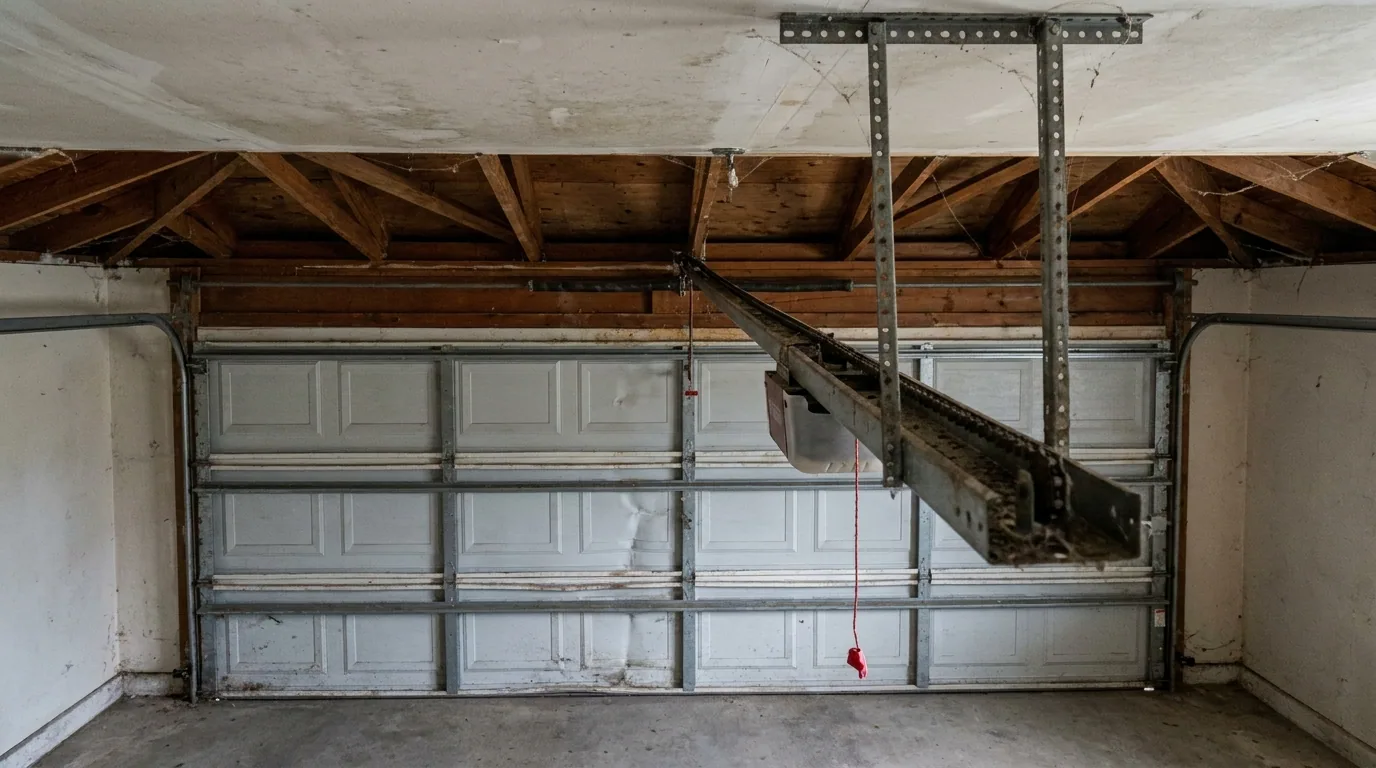
- How the unit sits. A backup that is buried under stored boxes, or whose housing is cracked or loose on its mount, is one you cannot easily watch. Keep the area around the opener head clear enough that the indicator stays visible.
If the indicator is dark, the housing looks damaged, or you are not sure what the light pattern means, that is the point to call a technician rather than open the unit. The battery and charger sit next to line-voltage components, and the work belongs to someone licensed and insured to do it. A technician can also run the backup through a cycle on battery power to confirm it holds a charge, which is not a test to run yourself.
When the door will not open and the power is on
A dead backup is one reason a door will not move during an outage. It is not the explanation for a door that will not move when the household current is fine. Those are different problems, and they are worth separating before you call anyone.
If the opener motor runs but the door does not move, the likely causes include a stripped gear in the opener, a broken torsion spring, or a door that has come off its track. If the motor does not run at all, the causes include a tripped breaker, a failed wall button, a safety sensor that is blocked or misaligned, or a fault in the opener's control board. A technician separates these by testing the opener, the springs, the cables, and the track in sequence. What you can note from outside the door, with the garage empty, is whether the door sits crooked, whether there is a gap along the top, whether it feels heavier than usual in normal use, and whether a new noise appears at the start of a cycle. Those observations help the technician narrow the visit before arriving.
Keeping the backup ready
The maintenance is simple, and most of it is a matter of remembering the unit exists. Have the battery checked periodically, especially before the summer storm season, and have it replaced when it no longer holds a charge. Keep the area around the opener head clear so the unit is not buried under stored items, and make sure the indicator light is visible enough that you would notice if it went dark.
If you are unsure whether your opener has a backup at all, or whether the one installed is still working, a technician can confirm it during a routine service visit. The Broken Spring Garage Door Repair LLC serves Sunrise, Fort Lauderdale, Tamarac, Plantation, Coral Springs, and Weston, and can be reached at 954-414-9504 or info@thebrokenspring.com. The office is at 4850 Northwest 103rd Avenue, Sunrise, FL 33351, with weekday hours of 7:00 AM to 7:00 PM and weekend hours of 8:00 AM to 6:00 PM. Emergency service is available.