A garage door that opens normally and then refuses to close from the wall button is a specific kind of failure, and a reassuring one in part. The opener is running, the springs are holding the door's weight, and the travel settings are carrying the door up the track the way they should. What has stopped working is the close command — either the button is not delivering it, or something in the opener's safety logic is refusing to act on it. That narrows the problem to a short list: a lock or vacation setting that has told the opener to ignore close commands, the safety circuit that watches the doorway during the down travel, or the wall console and its low-voltage wire. This article walks through those in the order that separates them fastest. The springs, cables, and drive train are technician work and are not part of this diagnosis.
First, confirm what still works
Before changing anything, run the same test twice so you know exactly what you are dealing with. With the garage empty and the door in view, press the wall button and hold it for a full second. Then press the remote and hold it the same way.
If the remote closes the door and the wall button does not, the door, the springs, and the opener's close logic are all healthy, and the problem is confined to the wall console, its wire, or a setting that affects only the wall control. If neither the remote nor the wall button will close the door, the console is not the culprit — go straight to the lock feature and the safety circuit below. If the door starts down and then reverses before it reaches the floor, that is a different symptom with its own causes, and the sections on the safety circuit and travel limits cover it.
Rule out the lock feature
Many openers have a lock or vacation mode that is designed to do exactly what you are seeing: it accepts open commands and ignores close commands from remotes and wall controls, so the door cannot be operated while you are away or while you are inside with the garage secured. It is usually engaged by holding a button on the wall console for several seconds, and it is easy to trigger by accident when someone leans on the console or wipes it down.
Check the console for a lock indicator — most units have a small LED that stays lit while the feature is active. If it is lit, hold the lock button again for the same several seconds and watch for the light to go out, then try a close cycle. If the console has no indicator, the opener's manual will name the button and the hold time. If the door closes normally once the light is out, the feature was the whole problem and nothing needs repair.
If the light will not go out, or if there is no lock feature on your unit, move on. Do not keep pressing buttons at random; each attempt adds noise to what you are trying to learn.
Check the safety circuit, starting with the photo-eyes
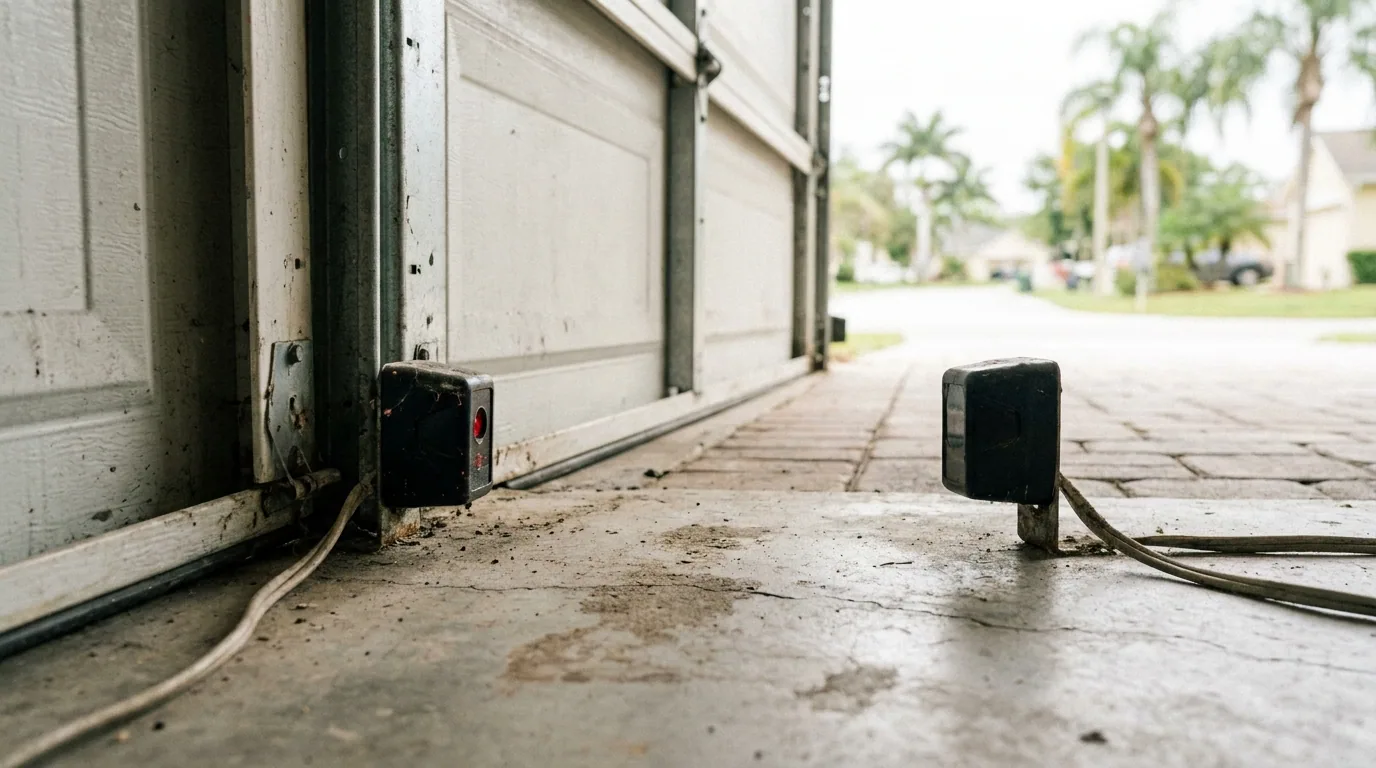
The photo-eye pair at the bottom of the opening is a safety device on the down travel. When the beam between the two units is blocked or the units are out of line with each other, the opener will refuse to close the door or will reverse it while it is closing. This is the one condition where the photo-eye is certain: a blocked or misaligned eye affects a door that is closing, and only while it is closing. It has no role in a door that will not start at all, so if your door does nothing when you press the button, this section is not your answer.
With the garage empty, crouch down and check that nothing is standing between the two units — a trash can, a bike, a bag of soil, a folded ladder leaning against the wall. Then check that each unit is still pointed at the other and that neither has been knocked sideways by a car bumper or a broom. Most units have a small indicator light on the receiving eye that behaves differently when the beam is made and when it is broken; the opener's manual will tell you which is which. Wipe dust off the lenses with a dry cloth. Do not loosen the brackets or attempt to realign the units by hand if they look bent — a technician sets those with the door and the opener in front of them.
If the eyes are clear, aligned, and lit, and the door still will not close, the safety circuit wiring is the next thing to rule out. The thin wires from each eye run back to the opener head and are stapled along the wall and ceiling. A staple driven too deep, a nick from a storage hook, or a wire pulled loose at the terminal will break the circuit the same way a blocked beam does. Tracing and repairing that wire is technician work; describe what you see and let them take it from there.
If the door starts down and then reverses
A door that begins to close and then goes back up before it reaches the floor is usually a travel-limit or force-setting problem, not a photo-eye problem. The opener has a down limit that tells it where the floor is and a force setting that tells it how much resistance to accept before reversing. If the limit has drifted, the opener thinks it has hit something early. If the force setting is too light, a slightly stiff track or a cold morning is enough to send it back up.
The symptom to note is where in the travel the reversal happens. A reversal a few inches off the floor points one way; a reversal halfway down points another. Write down what you observe and how often it happens, and pass that to a technician rather than adjusting the limit screws yourself — those settings interact with the door's weight and the springs, and a wrong setting can leave the door unable to close at all.
When the wall console itself is the problem
If the lock light is out, the eyes are clear, and the remote closes the door while the wall button does not, the console or its wire is the remaining suspect. The console carries a low-voltage signal to the opener head, and that wire is the most common failure point — it runs through the garage where it can be pinched, chewed, or pulled loose at either end.
Check the terminal block at the opener head with the power off at the wall switch, and confirm the two console wires are seated where the manual shows them. If they are secure and the button still does nothing, the console has likely failed and needs replacement. A console swap is straightforward, but if the wire itself is damaged inside the wall, that is a technician's job. The springs, cables, and opener drive train stay off your list throughout — those are inspected and serviced by a technician, and nothing in this article asks you to touch them.
If you have worked through the lock feature, the photo-eyes, and the console wire and the door still will not close from the wall button, call 954-414-9504. The Broken Spring Garage Door Repair LLC serves Sunrise, Fort Lauderdale, Tamarac, Plantation, Coral Springs, and Weston, is licensed and insured, and offers emergency service outside regular hours. Weekday hours are 7:00 AM to 7:00 PM and weekend hours are 8:00 AM to 6:00 PM. You can also reach the office at info@thebrokenspring.com or at 4850 Northwest 103rd Avenue, Sunrise, FL 33351.