A garage door that comes down partway, stops, and climbs back up is one of the more common calls a garage door technician gets, and it is also one of the most misdiagnosed from the floor of the garage. The instinct is to blame the safety sensors, because the photo-eye is the part everyone has heard of. But the photo-eye is a safety device on the closing travel, and it only does its job while the door is on its way down. Whether it is the cause of your particular reversal depends on exactly where the door turns around, and on a few things you can observe without touching any hardware. This article covers what the different patterns look like, how to narrow them down, and where the work stops being homeowner work.
Be precise about where the door turns around
"It reverses" covers several different behaviors, and they point in different directions. Watch a full cycle from outside the door with the garage empty and note exactly where the door turns around.
- It reverses a few inches off the floor. The door travels almost all the way down, then goes back up. This is the classic travel-limit or force-setting pattern. The opener believes it has reached the floor before it actually has, or it meets enough resistance near the bottom that it treats the resistance as an obstruction and reverses.
- It reverses immediately after starting down. The door barely moves before it climbs back. This is the pattern where a blocked or misaligned photo-eye is a genuine suspect, because the door was closing and the safety beam may have been interrupted at the start of the down travel.
- It reverses partway down, at no consistent point. Sometimes high, sometimes low. An intermittent interruption of the beam, a loose sensor bracket, or a wiring problem can all produce this, and so can a binding track. The technician sorts these out on site.
Knowing which of these three you have is most of the diagnosis. The rest of this article works through the second and third patterns, where the sensor is in play.
What the safety eye actually does
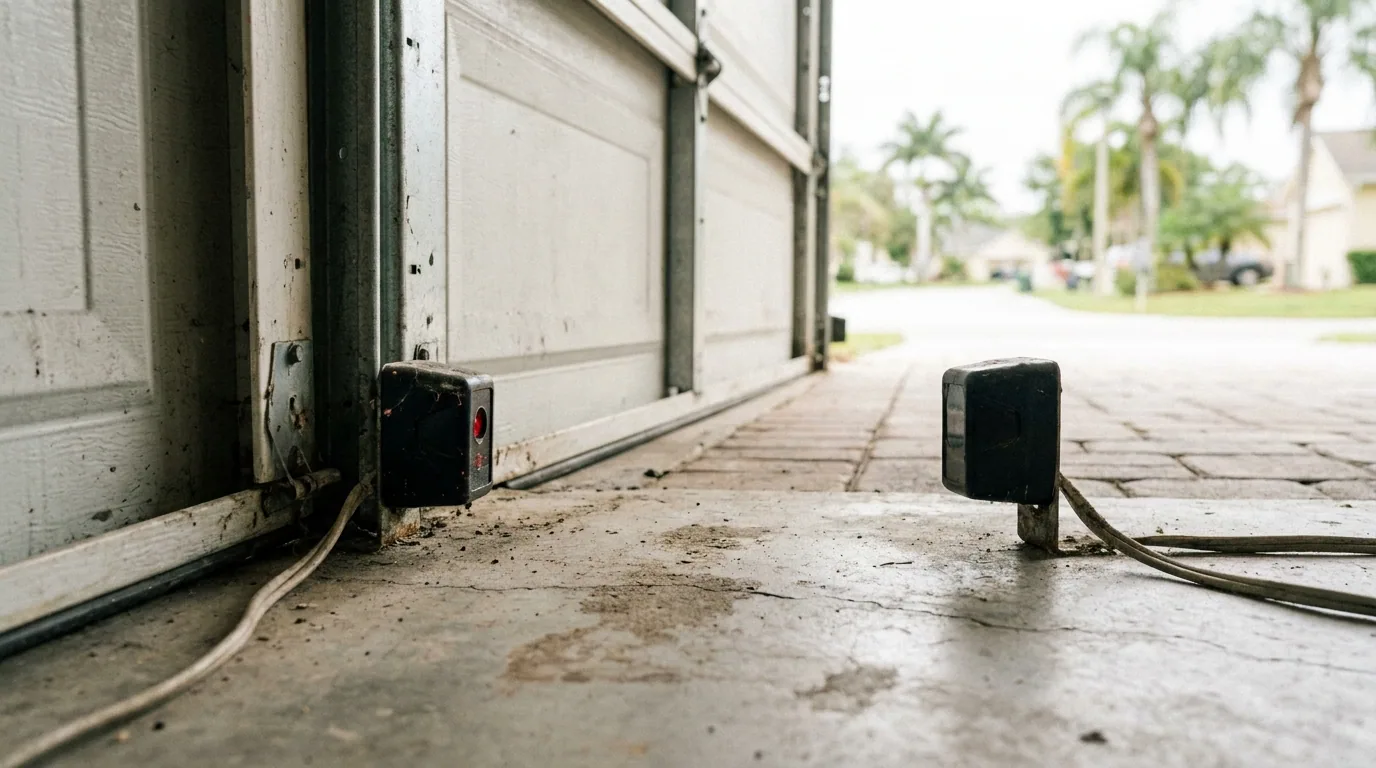
The photo-eye is a pair of small units mounted at the bottom of the tracks on either side of the opening, one sending an invisible beam across the doorway and the other receiving it. While the door is closing, if something breaks that beam, the opener reverses the door. That is the whole job. It is a safety device on the down travel.
This matters because the photo-eye has no role in a door that will not start at all, a door that opens a little and then reverses, or a door that stops short on the way up. If your door is reversing on the way up, the sensor is not your problem, and adjusting it will not fix anything. The same is true of a door that reverses a few inches off the floor: that is a travel-limit or force-setting pattern, not a sensor pattern.
Why the Florida afternoon sun gets blamed, and when it deserves it
Sunlight can interfere with a photo-eye. The receiver is looking for a modulated infrared beam from the sender, and direct low sun shining into the receiver lens can overwhelm it. When that happens, the receiver behaves as though the beam is broken, and a door that is closing reverses. This is why the problem often shows up in the late afternoon and not in the morning, and why it can come and go with the season as the sun's angle changes.
What you can observe: note the time of day the reversals happen and whether the door closes normally at other times. If the door only reverses in the late afternoon, and closes without trouble in the morning or after dark, sun interference is a reasonable suspect. If it reverses at all hours, look elsewhere. The technician confirms it on site and deals with the mounting and alignment.
What not to do: do not loosen the sensor brackets and start moving them around to chase the sun. The brackets are set to a specific alignment, and once moved, the beam may no longer line up across the opening. That turns an intermittent problem into a constant one.
What a homeowner can safely do
With the door fully open and the opener switched off at the wall control, a few things around the sensors are safe to clear.
- Obstructions in the beam path. A broom handle, a recycling bin, a bag of soil, or a child's toy left in the doorway between the sensors will do it. So will a cobweb or a leaf stuck to the lens. Clear the path and wipe the lens with a dry cloth.
- Something hanging into the beam. A pull rope, a hanging plant, or a bike handlebar stored near the opening can break the beam without sitting on the floor.
- Visible damage to the sensor or its wiring. A cracked lens, a sensor hanging loose on its bracket, or a wire pulled taut or chewed is technician work. Do not attempt to reattach or rewire it.
If the path is clear, the lens is clean, and the door still reverses at the start of the down travel, stop there. The next steps involve the alignment, the wiring, and the opener's settings, and all of those belong to a technician.
What the technician does that you should not
When a technician arrives for a reversal complaint, the work usually runs through the same sequence: confirm which direction the door was moving and where it turned around, check the sensor alignment across the opening, check the wiring and the connections at both units, and then check the opener's travel limits and force settings. The springs and cables get inspected at the same time, because a door that binds on the way down can trigger a reversal that looks like a sensor fault.
None of that is homeowner work. The springs, the cables, and the opener's drive train are under tension and are not things to adjust or inspect yourself. The travel limits and force settings are also easy to make worse, and a door that is set to push harder than it should is a safety problem, not a fix.
If your door is reversing before it reaches the floor and clearing the beam path has not changed anything, call a technician. The Broken Spring Garage Door Repair LLC serves Sunrise, Fort Lauderdale, Tamarac, Plantation, Coral Springs, and Weston, and can be reached at 954-414-9504 or info@thebrokenspring.com. The company is licensed and insured, and emergency service is available.