A wet strip along the inside of the garage door after a summer storm is one of the most common calls a garage door technician gets in this part of Florida, and it is easy to assume the door itself has failed. Often it has not. Water can cross the threshold at the bottom seal, at one jamb, at the top of the frame, or under the floor slab itself, and each of those leaves a different pattern on the concrete. The useful question is not whether water is getting in but where it crosses. A wet line that runs the full width of the door is a different problem from a puddle in one corner, and the two call for different work. This article covers how to read the pattern after a storm, what each one points to, and which parts of the job belong to a technician. The springs, cables, and opener drive train stay off your list entirely — those belong to a technician.
Read the wet pattern, not the puddle
Water spreads once it is inside, so the puddle is rarely sitting where the leak is. The better clue is the leading edge — the darker, damp line at the boundary of the wet area. That edge usually points back toward where the water crossed. A damp strip that runs parallel to the door, close to the threshold, tells you something different from a wet patch that starts at one end and fades toward the other, and both differ from a drip mark on the wall above the opening.
If the storm has already passed and the floor has dried, you can still work from the evidence. Staining, a faint mineral tide line on the concrete, or a soft spot in the paint along the inside face of the door will often survive a day or two of drying. Note where the mark starts and which direction it runs. That is the observation that matters when you call.
Pattern one: a wet line across the full width of the door
A thin wet strip that runs the entire length of the opening, with the rest of the floor dry, points to water crossing under the bottom seal. The bottom seal is the rubber or vinyl strip along the lower edge of the door, and it is meant to compress against the floor when the door closes. It does that job only if the door comes down far enough and the floor beneath it is reasonably even.
Several things can produce this pattern:
- The bottom seal has hardened, cracked, or pulled away from its retainer.
- The door is stopping slightly above the floor because the down travel limit is set short.
- The floor has a low spot or a slope that lets water run toward the opening.
The technician separates these by checking the seal, the door's closed position, and the floor line together. That is the right scope for the call: weather seal work is a garage door job, and a floor that drains toward the opening is a separate repair. What you can do safely is note whether the wet strip is even across the width or heavier at one end, and whether it appeared during a driving rain or after the storm had passed.
Pattern two: water in one corner or down one jamb
Water that collects at one end of the door, or runs down the inside of one side jamb, is usually entering at the edge rather than the bottom. The door sits inside a frame, and the gap between the door's edge and the jamb is a path for wind-driven rain. A storm that pushes rain sideways will find that gap even when the bottom seal is sound.
The jamb weatherstripping and the top weatherstrip are the same kind of material as the bottom seal and age the same way. When it has pulled loose, flattened, or gone brittle, wind-driven rain can pass behind it. A wet line that starts high on one side and runs down to the floor is a strong sign the water is coming in at the jamb rather than under the door.
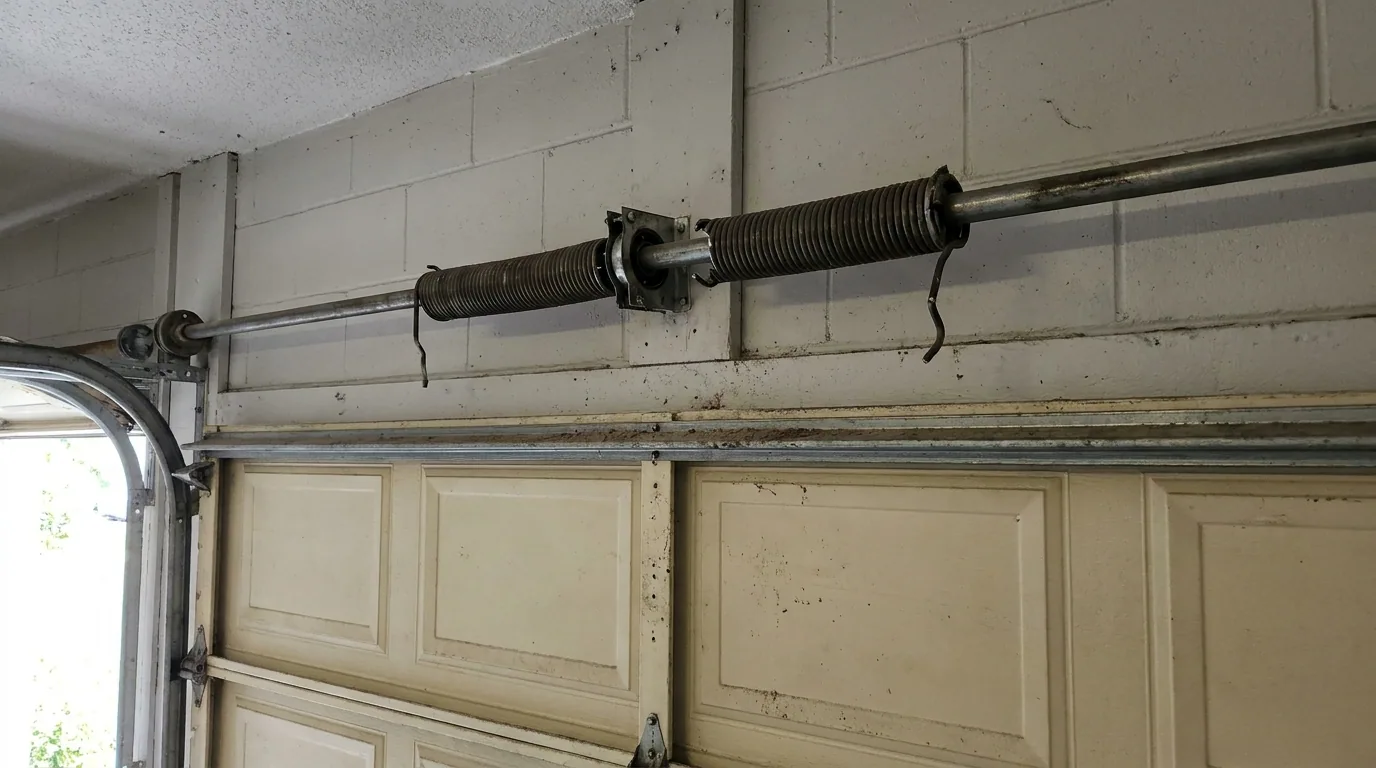
One caution worth repeating: a door that hangs crooked or binds on one side can leave a wider gap on that side, and a crooked door has several possible causes — a slack or snapped cable, a spring that has lost tension, or a track knocked out of line. A technician checks the springs, cables, and track to tell you whether the gap is a seal problem or an alignment problem. Do not try to correct the door's position yourself.
Pattern three: water at the top of the door or on the header
Water that appears on the wall above the door, or drips onto the top panel, is entering above the opening. The top weatherstrip is the first suspect, but it is not the only possibility. Wind-driven rain can be forced under a fascia or through a gap where the door frame meets the wall, and it can travel along the framing before it shows up inside.
This pattern is the hardest to trace because the visible wet spot is often downstream of the actual entry. A damp streak that runs down the wall from a point above the door frame is worth following upward with your eyes. If the entry turns out to be above the door and behind the frame, the repair is usually carpentry and flashing rather than a door part, and it is worth having it looked at before the next storm rather than after.
What to do before the next storm
Once you know which pattern you have, the practical steps are straightforward. Clear the garage floor so water has somewhere harmless to go. Keep gutters and downspouts clear so roof water is carried away from the opening rather than dumped beside it. If the bottom seal or jamb weatherstripping is visibly worn, that is a repair a technician can handle along with a check of the door's travel and alignment.
If the door itself is sitting unevenly, stopping short, or making a new noise at the start of a cycle, mention that when you call. Water intrusion and a door that is out of adjustment often show up in the same season, and both are worth a look. The Broken Spring Garage Door Repair LLC serves Sunrise, Fort Lauderdale, Tamarac, Plantation, Coral Springs, and Weston, is licensed and insured, and can be reached at 954-414-9504 or info@thebrokenspring.com. Emergency service is available.